
This morning, two drones hit the Sparta II, a cargo ship bound for Kaliningrad, in the Gulf of Finland. It caught fire and drifted into Finnish waters, and Finland closed the air and sea around it. That made 89.
Since October 26 we have logged every drone event that made our daily TKG Alert: 89 in 27 days. Each event is counted once, with follow-up reports merged into the original. It is not a census of every drone incident in the world. We pick three stories a day, and a few older events only surfaced this month. But a month of the same log, kept the same way, shows a direction.
Most of it was energy
Of the 89 events, 43 were strikes on energy infrastructure: substations, power plants, refineries, pipelines and fuel depots. Another 29 were security incidents at airports, bases, prisons, ports and stadiums. The remaining 17 were governments responding, testing or writing rules.
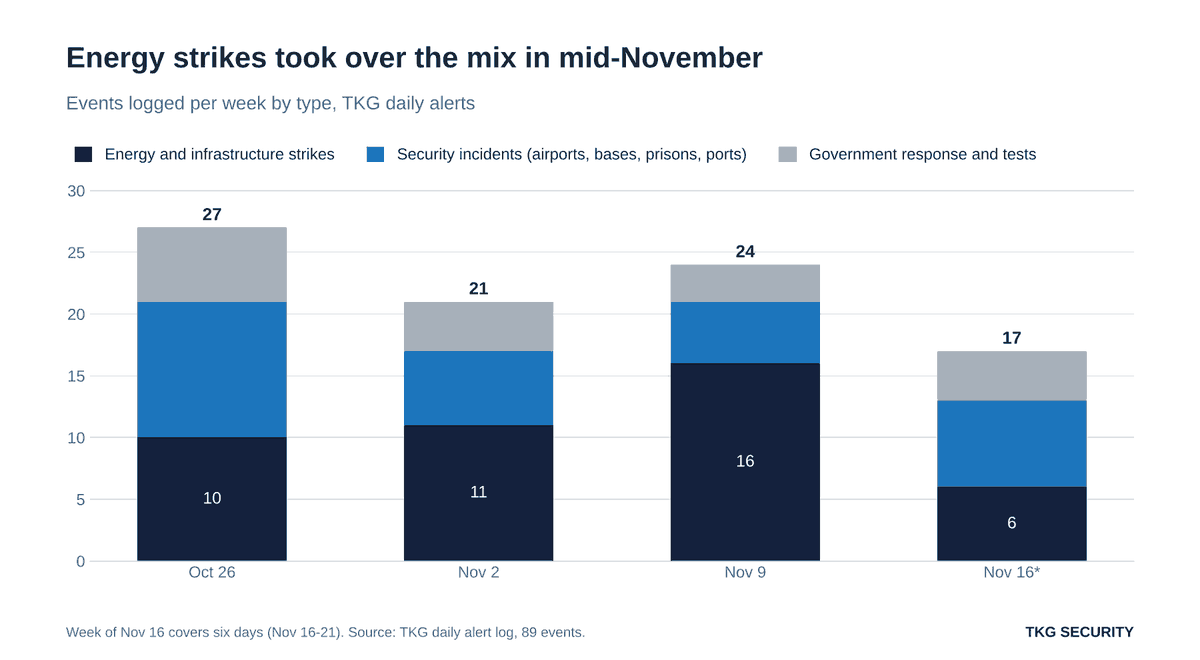
The weekly count barely moved, staying between 21 and 27 for every full week. The mix did move. In the first week, energy strikes were 10 of 27 events. In the week of November 9 they were 16 of 24.
| Region | Energy strikes | Security incidents | Government response | Total |
|---|---|---|---|---|
| Russia | 18 | 3 | 0 | 21 |
| Europe and NATO | 0 | 15 | 4 | 19 |
| Ukraine | 16 | 0 | 2 | 18 |
| Americas | 1 | 7 | 9 | 17 |
| Middle East | 5 | 1 | 0 | 6 |
| Africa | 3 | 1 | 0 | 4 |
| Asia-Pacific and global | 0 | 2 | 2 | 4 |
| Total | 43 | 29 | 17 | 89 |
The split by region matters as much as the totals. The energy strikes sit almost entirely in Russia and Ukraine, with Sudan, Iraq, Saudi Arabia and Colombia making up the rest. The security incidents cluster in Europe and North America, where most of our customers operate. None of those were attacks. They were closures, lockdowns and arrests, and that is the part a site owner here can do something about.
Bigger nights, longer reach
Event counts are a weak measure of the threat, since the alert carries only three stories a day. The size of each night is a better one, and it kept climbing.
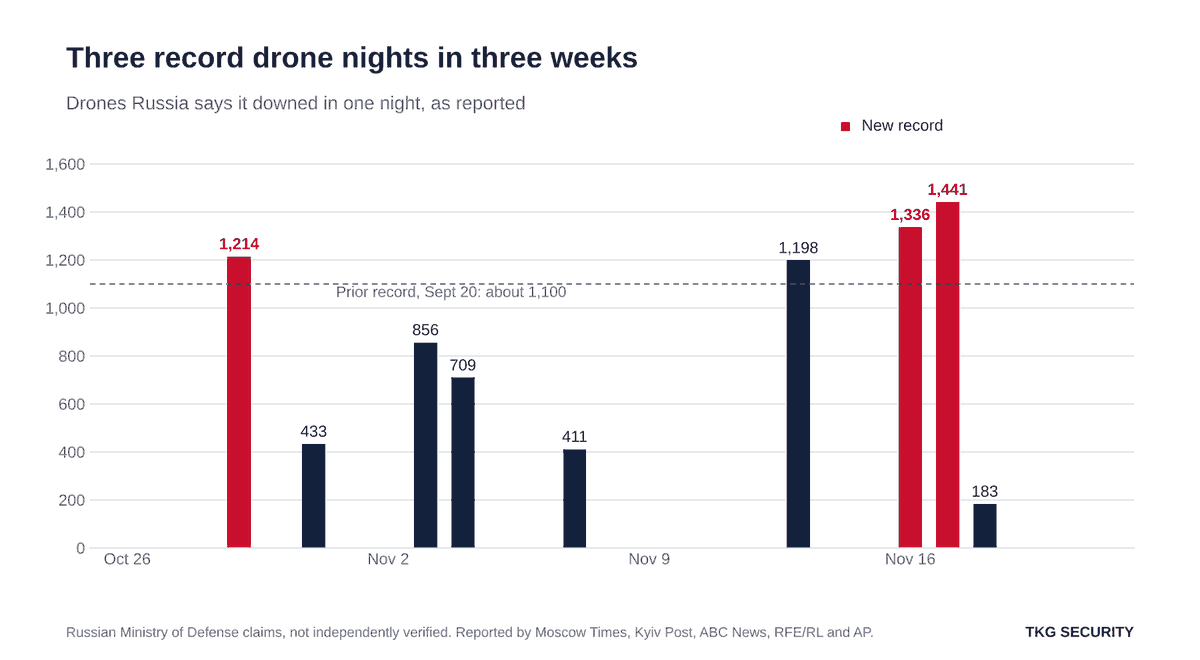
Russia claimed a record 1,214 drones downed on the night of October 28. It beat that on November 15 with 1,336, and again the next night with 1,441. Those are one side's claims, and we cannot check them. Ukraine reports the same scale coming the other way: 404 Shaheds and more than 84 missiles on November 19, enough to force its nuclear plants to cut output.
The damage compounds. Reuters' industry sources put idle Russian refining at about 30% on November 10. By November 18 it was 45%, with 15 of 35 major refineries disrupted.
The reach keeps growing too.
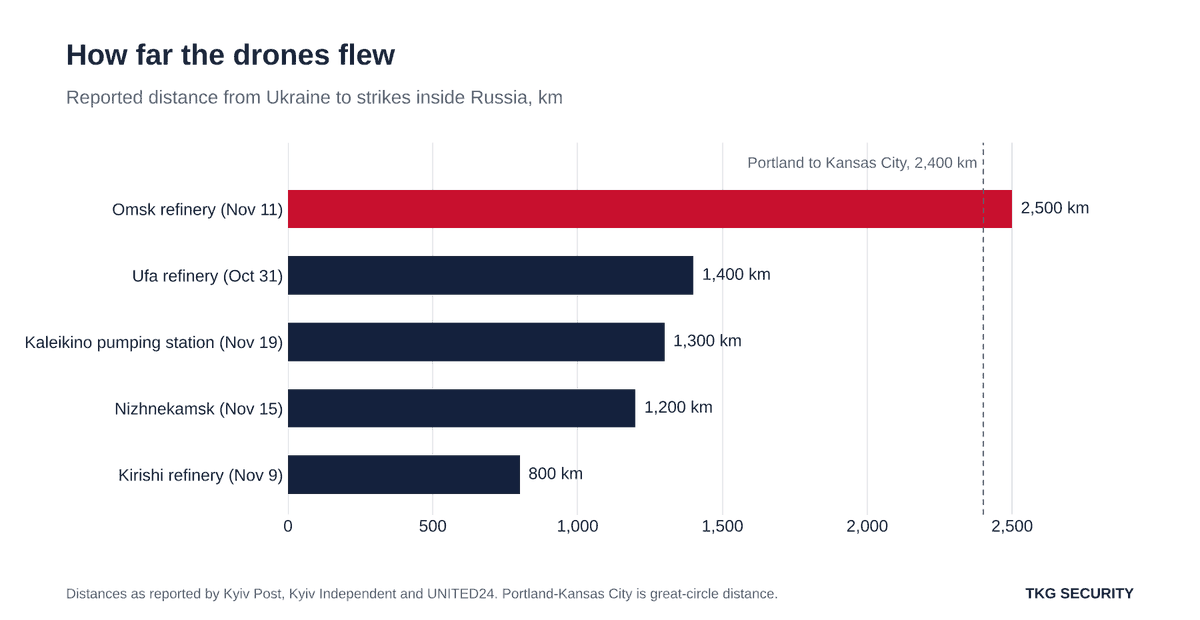
Omsk is about 2,500 km from Ukraine, a little farther than Portland to Kansas City. A refinery that far from the front used to be protected by distance alone. That assumption is gone, and so is the one many U.S. sites still make: that nobody would bother with them.
Speed is changing as well. Of the 404 drones on November 19, 123 were jet-powered. At roughly 600 km/h, a jet Shahed covers 10 km in a minute. Ukraine's interceptor drones bring down about 90% of the propeller-driven models, but they struggle to catch the jets.
Closer to home, the cost is closures
Nobody is flying Shaheds at a U.S. utility. What sites in Europe and North America lost this month was time, mostly to objects nobody could identify.
- Jersey Airport had drones two nights running, October 30 and 31. Seven flights diverted and no operator was found. Detection equipment arrived afterward.
- Leipzig/Halle closed runways on November 7 and 8, and neither pilot was found. On November 14 the airport's drone defence picked up a 19-year-old, and federal police caught him.
- RAF Lakenheath ordered personnel to shelter on November 13. A ferry pilot later said the "drones" were his three Cirrus SR20s, only one with its transponder on. The Air Force has not confirmed it.
- CFB Trenton's detection system was offline during a power outage when a drone flew near the base in September 2025. Days later, with power back, it missed another one. The records came out this month.
- Reagan National: the FBI is still looking for three men who flew a drone nearby on October 29. Genoa closed its airport on November 19, the same night Paris CDG briefly held arrivals.
- Prisons: a drone alert at the Coleman federal prison in Florida led to four arrests. A South Carolina man got federal time for a prison drop, and a Texas man got 25 years.
Three lessons come out of that list.
Identify before you close. Jersey's sightings were by eye. Lakenheath may have been light aircraft. A report with no track cannot be confirmed or dismissed, so the safe answer is to stop everything. Radar, RF and aircraft tracking on one screen is what tells a drone from a Cirrus.
Plan for the sensor going down. Trenton had a system and still missed two drones. Backup power, overlapping sensors and health alerts belong in the design from day one.
Connect detection to someone who can act. Leipzig's first two closures ended with nobody caught. The third ended in an arrest because detection was tied to police on the ground. Coleman worked the same way.
What a private site can do under today's rules
In the U.S., taking a drone down is still a government job. The list of agencies that can do it grew this year, but it still does not include whoever runs the substation, airport or data center.
| Who | Can they mitigate a drone today? | Conditions |
|---|---|---|
| Federal agencies (DoD, DOE, DHS, DOJ) | Yes, at covered facilities and missions | Existing federal counter-UAS authorities |
| State, local, tribal and territorial police | Yes, under the SAFER SKIES Act and the July 2026 interim rule | FBI certification, FCC authorization for RF systems, FAA coordination and notice to air traffic control |
| Utilities, airports, data centers, stadiums and other private operators | No | Detect, record and report. Flight restrictions only through a government sponsor for now |
The police route is narrow so far. The Congressional Research Service counted 61 officers in 46 agencies trained as of July 1. The rule does allow standing plans of up to 365 days at ongoing sites such as critical infrastructure. That is exactly the conversation a utility or airport should be having with its sheriff.
Detection, on the other hand, is open today. RF, Remote ID, radar and cameras receive and do not transmit, so they work under current law. Fused into one track with a logged history and a pilot location, they give police something to act on and prosecutors something to use.
Range is the first number to settle. A jet drone at 600 km/h seen at 10 km gives you about 60 seconds. A quadcopter at 15 m/s seen at 2 km gives you a little over two minutes. Every response you plan, whether that is sheltering staff, holding a runway or calling dispatch, either fits inside that window or it does not.
What we would do in the next 90 days
- Work out how many seconds of warning each response at your site needs, and set your detection range from that.
- Put passive detection (RF and Remote ID) on your most exposed site and cue cameras from it. Add radar where drones may fly without a radio link.
- Put the system on backup power and alert on sensor health.
- Write a response playbook with local police, drill it, and ask whether they plan to get SAFER SKIES mitigation certification.
- Get a Section 2209 application ready. Once the FAA finalizes it, critical infrastructure can request flight restrictions over its own site.
The money is starting to follow. FEMA's second $250 million counter-UAS grant round is due to announce awards on December 10.
The drones in this log flew farther and in bigger numbers almost every week. The ones over airports and bases mostly flew away unidentified. Both problems start in the same place: seeing the drone early and knowing what it is. That is where we would spend the first dollar, and it is what CoreCommand was built to do.
Planning tools (free, no sign-up)
Drone Incident Response Playbook (Word) · Range and Warning Time Planner (Excel) · Drone Incident Log and Planner (Excel)
Want help applying it to your site? Talk to a TKG engineer.
How we counted. Events come from TKG's daily drone alerts, October 26 to November 21, 2026, with follow-ups merged into the original event. Nine events happened earlier but were first reported in this window. Drone counts and damage figures are often claims by one side of a conflict and were not independently verified. Key sources: Reuters via U.S. News (refining), Kyiv Post (1,441-drone night), Ukrinform (November 19 attack), CTV News (CFB Trenton), DroneXL (Lakenheath), news.de (Leipzig), Reuters via WHBL (Sparta II). This is not legal advice; check with counsel before deploying anything that transmits.